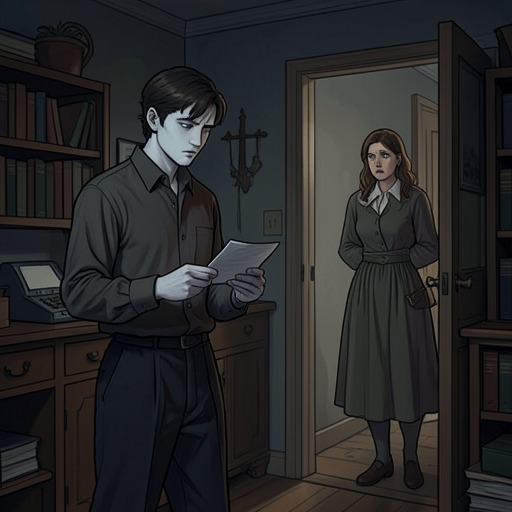
Couvent où se retire Mme de Tourvel
Les liaisons dangereusesThe convent whose room Présidente de Tourvel once occupied as a boarder is an unnamed religious house with a formative place in her life. Raised there, she has retained the habit of visiting; when she returns in distress, the familiar room becomes a refuge she insists she should never have left. The convent’s significance lies in this double role: it is an institution of her earlier upbringing and, later, the setting in which her crisis becomes visible to others.
Identity and Setting
The text does not give the convent a formal name or specify its location, order, or rules beyond the circumstances of Présidente de Tourvel’s reception. It does establish a community with a prioress and resident nuns, rooms for pupils, and a chamber Présidente de Tourvel occupied when she lived there as a boarder. Her prior residence explains why she can enter as a familiar visitor and why the room carries such force for her when she returns.
The convent also belongs to a wider social context in which convent education is associated with the upbringing of unmarried girls. The text does not establish that Cécile Volanges attended this particular house, but it presents cloistered education as a recognizable feature of marriage arrangements and female formation. The convent’s specific history with Présidente de Tourvel should therefore be distinguished from that broader convention.
Présidente de Tourvel’s Return
Présidente de Tourvel arrives around eleven in the morning with her maid, Julie, and is initially received as usual. She appears calm and in good health. About two hours later, she asks whether the room she occupied as a boarder is vacant. Once told that it is, she asks to see it, accompanied by the prioress and several nuns. There she announces that she has come back to live in the room and refuses the idea of leaving it again.
The prioress and the other nuns point out that Présidente de Tourvel is married and cannot be received without special permission. Their objection identifies a practical boundary between her personal insistence and the convent’s obligations. She persists, refusing to leave either the house or her room. By seven in the evening, the community agrees to let her stay for the night; her carriage and attendants are sent away, and a decision about what to do next is deferred until morning.
A Community Witness to Her Crisis
The account emphasizes that Présidente de Tourvel’s distress is not immediately apparent as uncontrolled behavior. During the evening she is described as composed and reflective, though she falls several times into deep reverie and cannot be drawn out of it by questions. When a nun asks whether she has a headache, she makes clear that her suffering is not located there. She then asks to be left alone and not questioned further.
Julie remains in the room because there is no other place for her to sleep. Later, Présidente de Tourvel grows agitated, eventually collapses into Julie’s arms, and refuses both food and assistance. After a disturbed night, she does not recognize Julie and rejects attempts to bring help. The convent’s residents and staff thus become witnesses to a change that unfolds within the supposedly familiar safety of her former room.
Admission, Care, and Significance
At seven the next morning, the prioress sends for a visitor, who hurries to the convent before daylight. Présidente de Tourvel briefly seems to recognize the visitor and takes her hand, but soon loses awareness again. The visitor remains at her bedside, while the account stresses the difficulty created by Présidente de Tourvel’s repeated refusal of care. The convent provides a place for others to stay near her, but the evidence does not present it as a cure or suggest that its religious community can resolve her illness.
The episode makes the convent more than a backdrop: its remembered room draws Présidente de Tourvel back, while its rules expose the limits on how the community can receive a married woman without special permission. Once she is allowed to remain, the house becomes the setting for a private collapse observed by the prioress, the nuns, Julie, and the visitor. Its history as a place of upbringing and its role as a refuge meet in a single room, where return offers shelter but cannot undo the crisis that brought her there.